Wargaming from Hertfordshire & Beyond!
Showing posts with label PMZ. Show all posts

Friday, 9 September 2011

PMZ Campaign: Hamburg

Report from General Schlemm,
commanding First Parachute Army
The battle for Hamburg, dated April 30th 1945
Having withdrawn to the Elbe, I have had little time to prepare my defences before the inevitable British attack. I still have the Panthers of the 101st Pz Brigade and I have also been allocated two companies of JgPanthers from the training schools, unfortunately they have little fuel or ammunition.
My right is resting on a large lake where I have placed a force consisting of Stugs and Panzer Grenadiers of the 116th Pz Divn supported by Volksturm and one company of JgPanthers. The 553rd Volksgrenadier Divn is holding a line of hills on the left with attached Stugs and JgPanthers. In reserve is the remainder of 116th Pz Divn with the Panthers.

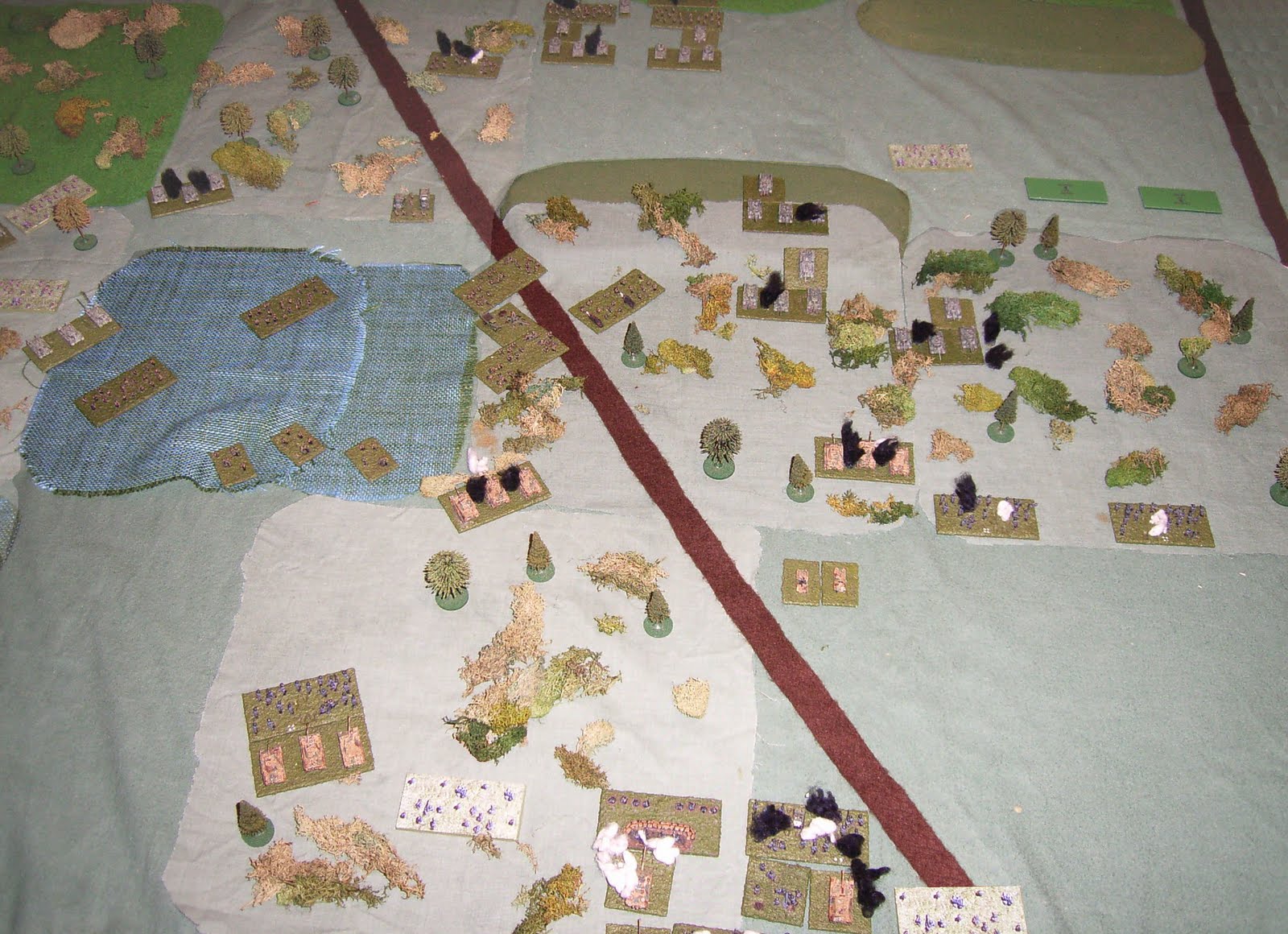
The British attack is beginning on the right. Here a single infantry battalion supported by JgPanthers holds, then throws back an infantry division supported by Sherman and Churchill tanks. Meanwhile a second British division is occupying a village on the far side of the river but is unable to cross due to heavy fire. Unnerved by this unexpected reverse, the attack appears to be faltering.

Now the British airforce attack in strength and they renew the attack on the right with another division, meanwhile sending amphibious units across the lake. The defending battalion has taken heavy losses, and at last retires, forcing the JgPanthers to retire as well. Taking advantage of this development, an armoured division is advancing on the left while the division in the centre has at last forced its way across the river.

--------------------------------------------------------------------------------------
The view from behind the German positions. The units defending the right have retreated, leaving the British in control of the village. Many British units are queing to cross the river. Some units of the 553rd Volksgrenadier Divn are holding the high ground against the British armoured division on the left. The reserve Panthers and Panzer grenadiers are about to move into action.
--------------------------------------------------------------------------------------

The Volksgrenadiers are retreating from the British armour, their single battalion of Stugs destroying many of the new Comet tanks before being itself destroyed.
I order the 116th Pz Divn to counter attack but they have been met by a wave of British armour and infantry.
German units are retreating all along the line with only a Panzer Grenadier battalion still intact, defending the supply centre.
Reports are confused but the Panthers appear to have retreated. Comet tanks are reported near my command post ..... ......... attacking ... ......... heavy fire ...... ..... overrun ........... ............

This was the final report by General Schlemm before his capture by our forces. With the destruction of First Parachute Army, and all available reserves being committed to Operation Spring Awakening in the East, there were no forces available to prevent us entering Berlin in early May. The British army is now occupying the Seelow heights while negotiations continue with the Soviets.

Friday, 26 August 2011

PMZ Campaign: Troyes 3

Report from General Fortsch,
commanding First Army
The third battle for Troyes, dated April 15th 1944
I had ample of time to dig in along the river line, anchoring my left on a large lake and my right on some wooded ground protected by minefields. Unfortunately my request for reinforcements had been denied so I was lacking armour, having only the 2nd Panzer Division with a reduced battalion of Panthers and some companies of StugIVs. The Jagd Panthers have been reallocated to another sector.
The Americans attacked initially on the right against the wooded ground with an armoured division. Leading the attack were some new Pershing heavy tanks. Fortunately they were stopped by the minefields in front of the concealed Panthers who made short work of them. This attack having been halted, the Americans then attacked the village in the centre with a second armoured division, the village was protected by a battalion of the 352nd Infantry division. This battalion held out for some time, delaying this attack.
The Americans then launched two attacks, an infantry division attacked on the left, driving back the 352nd Infantry from the river and a third armoured division attacked on the right, supported by intense airpower. Eventually this assault took its toll on the few remaining tanks of 2nd Panzer and it was forced to retire.

--------------------------------------------------------------------------------------
The view from behind the German positions. The 2nd Pz Divn has retired on the right, the Americans have yet to exploit this. The 352nd Inf Divn is holding out on the high ground and left of the road but they are soon to retreat. Some units of the 272nd Volksgren Divn can be seen in the centre.
--------------------------------------------------------------------------------------

With our forces retiring, it was left to the 272nd Volksgrenadier division to hold the line which they did gallantly. However the American armour had now crossed the river and the 272nd were unable to prevent them overrunning the Corps command centre.
Realising that the position was compromised, I ordered the withdrawal of the army towards Metz.


Tuesday, 16 August 2011

PMZ Campaign: Gorzow

Report from General Dietrich,
commanding Sixth Panzer Army

The battle for Gorzow, dated April 8th 1945

As part of operation Spring Awakening, I had been given the task of driving the Russians back from the borders of the Fatherland. The Fuhrer had allocated all the armoured reserves to this attack and great things were expected, we were not to disappoint him. Poor weather had grounded the Red airforce so we attacked under a ferocious artillery bombardment which however proved fairly ineffective. I had been promised all available aircraft, but apparently the bad weather made them ineffective as well. The Russians were occupying a line of hills with a large area of wooded ground in front of them.
The 1st SS Pz Division attacked on the right with the few tigers available, their task being to outflank the main defences. The 3rd SS Pz Division with attached PzIVs advanced through the woods. On the centre left the 16th Panzer Division with its Panthers and half of the Jg Panthers advanced cautiously against the centre of the Russian position keeping concealed as much as possible. The 232nd Pz Grenadier Division with PzIVs and the remainder of the Jg Panthers swung round the left flank.
The 1st SS engaged T34-85s at the far side of the woods and confidently outmanoeuvred them, destroying many in the process. These Soviets now came under pressure from the 3rd SS advancing through the woods and were forced to withdraw.
Meanwhile in the centre the 16th Pz had taken up position behind a crest line and awaited instructions. On the left the 232nd PzGren were advancing rapidly and beginning to push the Soviets back through the woods on that flank.
At this point the Soviets committed their reserves, Guards with sherman tanks against 10th and 30th SS. As soon as they did this, the 16th Pz attacked in the centre, slowly driving yet more T34s off the high ground. Meanwhile the 232nd PzGren were emerging from the woods into the Soviet rear area. The guards fought a bloody battle with the SS at close range, both sides eventually losing most of their tanks and being forced to withdraw.

--------------------------------------------------------------------------------------
The view from behind the German positions. The 1st SS is advancing on the right having driven off the T34s. The guards have moved forwards to oppose them. The 3rd SS have moved through the woods on their left. 16th Pz have moved up onto the high ground and are about to drive off the T34s and Polish infantry in front of them. The 232nd on the left are advancing into the soviet flank. Wrecked Soviet units can already be seen streaming to the rear.
--------------------------------------------------------------------------------------

The 16th Pz had now cleared the high ground and were advancing directly into the centre of the Soviet position at the same time as their remaining units were being surrounded by 232nd PzGren. At this point the Soviet command knew all was lost and began a headlong retreat. We pursued them as far as Lodz, where we were forced to stop for lack of supplies. We had retaken all the ground lost since February. It is rumoured that the Soviet front commander has been shot and that I will receive another addition to my Knight's Cross.


Thursday, 21 July 2011

PMZ Campaign: Lodz

Report from General Graser,
commanding Fourth Panzer Army
The battle for Lodz, dated Mar 20th 1945

I deployed the newly arrived Grossdeutchland division on my left, with its flank protected by a large lake. The 16th Pz Division was in the centre on a line of hills, the 72nd Infantry Division on the right with its flank protected by wooded ground.
The Soviets began their attack in the centre with the Guards tank corps with its JSIIs, ISU152s and new SU100s. This attack was driven back mainly by the Panthers of 16th Panzer. On the right, the 72nd Infantry kept the Russian infantry at bay.

--------------------------------------------------------------------------------------
The view from behind the German positions. The Panthers on the hills have driven back the Russian guards in the centre although some of 16th Pz have retired with considerable damage. Grossdeutchland on the left have made a tactical withdrawal.
--------------------------------------------------------------------------------------

The Soviets then attacked on the left with a Polish division supported by tank brigades and the Red airforce. With the 16th Panzer occupied by a renewed attack by the guards, Grossdeutchland began to give ground. Russian infantry then used amphibious vehicles to cross the lake. The guards were again driven back but the Poles broke through and overran the main supply dumps.
I considered the position to be untenable so requested permission to withdrew towards Gorzow. Taking no reply as an affirmative I immediately withdrew.

Friday, 3 June 2011

PMZ Campaign: Essen

Report from General Schlemm,
commanding First Parachute Army
The battle for Essen, dated March 20th 1945
Having had two months to prepare my defences I deployed my troops behind a riverline in heavy defences.
The key to the position was a line of hills. Here I placed the 422nd Infantry Division supported by a battalion of Panthers from the 101st Pz Brigade and some armoured engineers. On the right was the veteran 422nd Infantry Division supported by a battalion of Panthers, while the left was defended by the newly arrived 18th Luftwaffe division supported by a battalion of PzIV and the King Tigers of Pz-Abteilung 503 and protected by minefields.
The attack began with a massive bombardment on the central hillline. At the same time I received reports of a mass parachute drop on the Elbe bridges. The British attacked with two armoured divisions in the centre while another attacked my left. The fire from the Panthers drove back attack after attack and inflicted huge losses on the British armour. The forward units of the 18th Luftwaffe took heavy losses aand eventually were forced to fall back to the embankment behind them. The British pursued fiercely and overran the rear positions before the Pz IVs and King Tigers could stop them. On the right the British attack was easily repulsed so those Panthers redeployed behind the centre. Many Typhoons were over the battlefield but they had little effect on the outcome.

--------------------------------------------------------------------------------------
The view from behind the German positions. The Panthers on the hills hold back the British tide but are soon to be forced back. Tanks from the right flank have moved into the woods behind them and are preparing to counter-attack. The 18th Luftwaffe on the left have withdrawn with the British in pursuit.
--------------------------------------------------------------------------------------

The continued assault in the centre eventually told and the last remaining Panthers were forced to withdraw from the hills. On the left the morale of the 18th Luftwaffe was broken and they retreated, taking the tanks with them. The redeployed Panthers now counter attacked the hill but were attacked in flank by mechanised infantry and forced back.
With the hill line lost and the British moving into the rear areas, I ordered a general withdrawal towards Bremen.


Friday, 15 April 2011

PMZ Campaign: Troyes 2

Report from General Obstfelder,
commanding First Army
The second battle for Troyes, dated February 25th 1945
--------------------------------------------------------------------------------------
The view from behind the German positions. Despite the units on the right having withdrawn to more defensive positions, German units still hold the central ridge and the riverline. The Americans have been driven back at all points.
--------------------------------------------------------------------------------------
Despite having fewer Panthers available due to their tranfer to face the British, the combination of the river and accurate fire from Jagd Panthers prevented the Americans making any progress.

Wednesday, 23 February 2011

PMZ Campaign: Warsaw

Report from General Graser,
commanding Fourth Panzer Army
The battle for Warsaw, dated Jan 24th 1945
Having been informed of the success of General Obstfelder against the Americans, I decided, like him, to place most of my units in concealed fortified positions lining the river with fields of fire commanding the ground in front.
Having lost all my heavy tank hunters in the previous battle, I deployed the 16th Pz Division in the centre guarding the river crossing, the 72nd Infantry Division on the left and the 254th Infantry Division on the right with its right flank protected by a large lake.
The Soviets attacked in force all along the line, their heaviest tanks in the centre. The first attack was driven back mainly by the Panthers of 16th Panzer, however they soon regrouped and attacked again. This time the Soviets were more successful, disabling many of the Panthers. All three German divisions fought stubbornly and the Soviets were again thrown back.
The Soviets then attacked for the third time. The units on the left were clearly exhausted and were easily held by the 72nd Infantry, however, the Guards Tank Corps in the centre, with JSIIs and ISU152s forced the 16th Panzer to withdraw, enabling them to cross the river. The 254th were then forced to give way as they were in danger of being outflanked.
--------------------------------------------------------------------------------------

The view from behind the German positions. The 72nd Infantry Division on the left have held the Soviets. 16th Pz have withdrawn in the centre and the Soviets have crossed the river in force.
--------------------------------------------------------------------------------------
I considered making a counter attack with my final reserve of armoured engineers together with the few remaining tanks. However, with little chance of success and the probable destruction of the entire Korps, I decided to give up Warsaw and withdraw in good order to my next defence line where I could regroup my units.

Tuesday, 22 February 2011

PMZ Campaign: Troyes 1

Report from General Obstfelder,
commanding First Army
The battle for Troyes, dated January 20th 1945

The river being the best defence line available, I decided to place most of my units in concealed fortified positions lining the river with fields of fire commanding the open ground in front. The Americans attacked in the centre right, throwing wave after wave of units against the 2nd Panzer division and elements of the 352nd Infantry division who steadfastly stood their ground. An advance on the extreme right was held up by heavily forested ground. An advance over the frozen swamp on the extreme left was stopped and eventually thown back by heavy fire from the 189th infantry division.
Eventually the advance on the exteme right outflanked the 352nd whose morale now gave way and they retreated. This in turn precipitated the retreat of the heavily pressed 2nd Panzer division from the vital river crossing, now that its flank was exposed.
--------------------------------------------------------------------------------------

The view from behind the German positions. The 189th Infantry Division on the left have repulsed the Americans. 2nd Pz are driving back the Americans in the centre. The Americans on the right have advanced across the river.
--------------------------------------------------------------------------------------
At this point I suffered a serious head wound so information is sketchy but it appears that the Americans were now exhausted having suffered very heavy casualties. Some infantry and recon advanced across the river but a counter attack by elements of the now unopposed 189th infantry division together with the remaining tanks of 2nd Pz stopped them and eventually drove them back across the river. The few Americans who had crossed the river on the right were withdrawn at this point.
I hope to rejoin my command before the next attack on the riverline.


Sunday, 5 December 2010

PMZ Campaign: Eindhoven 2

Report from General Sclemm,
commanding First Parachute Army
The 2nd battle for Eindhoven, dated December 29th 1944
General Student has been transferred to the East front.
Upon taking command I placed my troops in heavy defences along the 'West Wall'.
In the centre of my position was a large lake. On the left was the 422nd Infantry Division and the 101st Pz Brigade with two companies of Jg Panzer IVs defending a ridgeline and wooded ground. On the right, on a ridge covering the main highway was a Kampfgruppe consisting of units of the 16th Luftwaffe Division with some Panthers of 101st Pz Brigade and some armoured engineers protected by minefields.

The attack began suddenly with no preliminary bombardment, the British obviously hoping to achieve surprise. Fortunately it was after dawn before the attack developed and we were fully alert. Armoured and infantry divisions attacked both sides of the lake directly into the accurate fire of our units. The British took massive losses, battalions streaming back to their start positions all along the line and both attacks grinding to a halt. We had taken few losses but all our units were fully engaged by the enemy.
--------------------------------------------------------------------------------------
The view from behind the German positions. The 422nd Infantry Division and the 101st Pz Brigade on the left have driven back most of the attacking units. The 16th Luftwaffe on the right are under heavy attack. The British amphibious infantry are about to cross the lake.
--------------------------------------------------------------------------------------
At this point a large force of infantry in amphibious vehicles advanced rapidly towards the lake. Our units were unable to respond to this move. The amphibious infantry moved across the lake, through and behind our positions, capturing the Korps headquarters. This precipitated a retreat all along the line and I have had to withdraw to the Rhine.

There were many British spotter planes overhead but luckily the dreaded Typhoons didn't make an appearance.

Saturday, 4 December 2010

PMZ Campaign: Brest Litovsk 2

Report from General Graser,
commanding Fourth Panzer Army
The second battle for Brest Litovsk, dated Dec 27th 1944
General Balck has been transferred to command Army group G and I have been appointed to command Fourth Panzer Army in his place. Fortunately there have been no major Soviet attacks in this area for 3 months which has given me time to reconstitute my forces.

I deployed the veteran 72nd infantry division on high ground dominating the main communications with their left protected by marshy ground, inpassable to vehicles. Their right was covered by elements of the newly arrived 254th infantry division with tanks from the 16th Panzer division which was in reserve.
The expected Soviet attack came just as the ground froze, making the marsh crossable and exposing the left of the 72nd. I immediately reinforced them with the JgElefants of Pz-Abt 512 and two companies of Jg Panthers, easily capable of stopping T34s.

After the usual massive artillery bombardment, a mass of Soviet tanks and infantry attacked our centre. Despite taking heavy casualties, the Soviets continued to attack, using a new type of T34 which appeared able to damage our vehicles. They also had large numbers of JSIIs, ISU152s and SU85s.
--------------------------------------------------------------------------------------
The view from behind the German positions. The Soviets have overrun the 72nd Inf who are retreating back on their line of communication. The 16th Panzer are endeavouring to hold the line but have lost many of their tanks by this stage.
--------------------------------------------------------------------------------------
Even with a gallant defence, eventually their numbers told and the 72nd were forced back, the 254th also giving way as they were in danger of being outflanked. Despite a valiant counterattack by 16th Pz Division, nothing could stop the tide of men and machines.
With this Soviet breakthrough in the centre, I ordered a strategic withdawal to my next defence line.

Friday, 3 December 2010

PMZ Campaign: Orleans 3

Report from General Obstfelder,
commanding First Army
The third battle for Orleans, dated December 24th 1944

General Knobelsdorff has been out of communication since his command centre was overrun on 17th December. Information on the battle is sketchy but it appears he deployed on a ridgeline with armour and infantry spread out along the front overlooking open ground. He had no heavy tanks available, but they were supported by two companies of Jg Pz4s.

The Americans attacked in mass and, while their lead units were forced back by accurate fire, the American airforce pounded our positions in great numbers, disrupting our front elements. Taking advantage of this, the Americans pushed forward with their second line and overran our forward positions, causing units all along the line to fall back. The Volkssturm units proved particularly unreliable.
--------------------------------------------------------------------------------------
The view from behind the German positions. In the foreground, the German units are withdrawing, badly damaged. The American airforce are bombing the remaing units on the ridge while their troops at the rear are poised to break through.
--------------------------------------------------------------------------------------
The Americans then committed their final reserve which punched though our line, overrunning the command centre and opening a wide corridor though our lines, precipitating the entire Korps to retreat. This in turn caused the First Army to withdraw to the river Seine.
I have been placed in command of First Army and am fortifying positions along the banks of the Seine with those units I have remaining.

PMZ Campaign: Soviet report

Ставка Главного Командования
Вооруженных Сил Союза ССР

STAVKA REPORT
Byelorussian Strategic Offensive
Report by Marshal Zhukov

The liberation of Byelorussia comprised three battles. Of particular significance was the preparatory phase during which we were able to draw off key defending units and mislead the enemy as to our intentions. By varying the strategic point of attack we were able to have the defenders misplace key units and enhance the value of our own attack units.

In the Battle of Bobruisk we faced a difficult initial combat to break into the enemy defences that were well anchored on hills and a lake while being fronted by wooded areas. Our tactical approach was to use tank formations on the clearer flanking areas and infantry assault teams in the central woods. The disadvantage was that we lost the option of synergy in mixing the combat arms and in general the approaches to the defences were too constricted by the choices made in developing our attack. Nevertheless, when able to close with the enemy we were able to overwhelm them and achieve a break-in. Particular note should be made of the efforts of the assault engineers who were highly successful in penetrating the enemy’s position. However, too much was asked of infantry that should be used to hold the ground seized and not enough use was made of the Tank Corps to fulfil the primary mission of taking objectives. From north to south the deployment was 9 Tank Corps, 18 Rifle Corps, 41 Rifle Corps, 130 Rifle Corps, 16 Tank Corps and 11 Tank Corps. However, the Rifle Corps entered combat sequentially making it easier for the defender to fend off our blows. Only in the north on the right flank did we have some success with 18 Rifle Corps and 9 Tank Corps making a coordinated attack. The key to this proved to be the attachment of the assault engineers with flamethrower tanks to 18 Rifle Corps and the use of follow-up units behind the main attack of both 18 Rifle Corps and 9 Tank Corps that could prevent successful counter-attacks. In classic military style the commitment of the final reserve could not be countered by the enemy who had been forced to commit all already. The northern wing troops were eventually able to prise open the defences and force the enemy opposing them to retire and that then caused the Hitlerite army to retreat for 125 kilometres. During this retreat the enemy was forced to abandon much equipment and as a result we have obtained examples of his most recent anti-tank guns and tank destroyers. These could be seen to be formidable developments as shown by his capacity to hold off our left flank attack with a single group of tank destroyers that were able to disable our tanks at extreme range.
- - - - - - - - - - - - - - - - - - - - - - - - - - - - - - - - - - - - - - - - - - - - - - - - - - - - - -
The break-in arising from the first battle then led to the Battle of Minsk. On this occasion the terrain was advantageous to us in being mainly clear with a wood and hills on the right, a village on the left and woods in the enemy’s flanking rear areas. This gave us the opportunity to develop a broad attack with each unit being able to readily support neighbouring units and enabled extensive firepower to be deployed as enemy positions were uncovered, quickly bringing suppressive fire down to disrupt his positions. Deployment from north to south was 18 Rifle Corps and 16 Tank Corps to assault the woods and hills on the right, 11 Tank Corps in the centre, 9 Tank Corps and 130 Rifle Corps on the left to seize the village and advance along the line of communications. Each tank corps was reinforced with an attached heavy-weapon gun regiment and this proved a successful tactic.
Extensive use was made of reconnaissance troops to identify enemy strong points prior to engagement. Rapid engagement of identified targets ensured quick suppression of the enemy positions and as a result reduced our own casualties. At this battle the enemy fielded for the first time his new heavy tank, which was immediately and successful engaged by the available SU85s. Particular mention should be made of the pilots of 16 Air Army supporting the attack whose ground attacks were prompt and accurate, ensuring that the enemy unit was not merely neutralised but destroyed. An unfortunate by-product was the lack of working models to examine. The debris showed thick armour and a powerful gun but a lack of engine power. That it is a potent weapon is shown by the damage inflicted on 11 Tank Corps, which took considerable casualties in the fire-fight with the main enemy defence line while engaging these new tanks. Our troops were able to cause rapid and significant damage on the enemy and most of his tanks were rendered inoperable early in the engagement. His forces hung grimly on suffering ever greater casualties until on the left flank and centre they broke in rout. On our right flank the terrain had slowed the approach to combat so his forces held there a little longer before fleeing. In handling the attack the unit commanders showed they were learning from their experiences in dealing with enemy forces. In the pursuit our right flank was able to overrun the enemy command complex, the centre to capture his forward supply depot and the left flank to advance onto his line of communications. With the Hitlerite army in flight we were able to capture extensive amounts of personnel and equipment, reducing his deployable forces for subsequent engagements and requiring him to draw extensively from reserves to reequip his forces. The pursuit also allowed the considerable unopposed advance of 375 kilometres.

Analysis of the correlation of forces at this point showed a continuation of combat to be unwise. In June we had the advantage of 2:1 in personnel and 3:1 in tanks. The intelligence assessment of our available forces at this point, compared to the enemy forces available at the new defence line under construction, suggested the position was 1.4:1 in personnel and 1.6:1 in tanks. Given that the Hitlerites would field more effective tanks than previously I considered it prudent to pause to rebuild strength, despite the fact that this would enable him to improve his defences. I suspected that in any future engagement the enemy would seek to field higher quality tanks in greater numbers and to cope with this I needed the full strength allocated to me by STAVKA available for battle. We had advanced 500 kilometres, one-third of the way to Berlin, and needed time to bring supplies forward and add replacements to our depleted ranks.
- - - - - - - - - - - - - - - - - - - - - - - - - - - - - - - - - - - - - - - - - - - - - - - - - - - - - -
The third and final battle in the offensive was the Battle of Brest-Litovsk. The terrain at this point proved most difficult as the route required us to pass between two woods, bounded by a lake and covered by a hill that had to be crossed. The wide open nature of the terrain allowed the employment of a mass tank attack but also permitted the Hitlerites a wide expanse to fire from longer range on attacking forces. Deployment from north to south was 41 Rifle Corps and 16 Tank Corps to assault the woods on the right, 11 Tank Corps in the centre to assault the hill complex, 9 Tank Corps and 130 Rifle Corps on the left to seize the woods and open a communication axis into the enemy rear area and advance along the line of communications. Each tank corps was reinforced with attached heavy-weapon units.
At an early stage in the advance the assault began to break-up under the intense fire of the enemy tanks and tank destroyers. Once again the main success against the heavy units of the enemy was achieved by aircraft. Extensive reconnaissance overwhelmed enemy scouting parties to identify the main lines of resistance. Valiant assaults by our troops closed on the enemy and began to break into his positions. On the left flank tank units broke through into his rear areas and threatened to overrun his command centre. In the centre an extensive and prolonged fight between the enemy units defending the hill area and the 11 Tank Corps developed. On the right flank our attacking troops closed with the enemy and forced him out of the wooded area, the advancing troops taking part of the hill defences and reaching close to his forward supply centre. Both the defending flanks were successfully taken and much credit must be taken by the Commissars in maintaining the fighting morale of the units in difficult circumstances, rally troops to further efforts by their exhortations. In the centre the enemy held grimly on to the main hill-line and the woods at the base of it. Intense anti-aircraft defences based on the hill and enemy fighter cover over the battlefield significantly reduced the impact of our air support units. Despite the utmost endeavours of the tanks and infantry who continued their assault until exhausted it proved impossible to shift the enemy from his positions. This prevented the proper exploitation of the successes we had achieved and our forces therefore commenced an orderly withdrawal to their start lines. A large percentage of the enemy had fled the battlefield but the Hitlerites retained sufficient strength to deny the Red Army its well deserved victory. Good tactical skill was once again shown by our commanders in their use of combined arms. However, it was clear that our tank attacks lacked sufficient power and an upgrade in this arm was needed before the next advance could be made. The enemy’s infantry had suffered many casualties and showed evidence of degraded performance but the tank arm still showed much determination.

At this point it was appropriate to close down the Strategic Offensive and commence the Memel-Baltic Offensive with the Second Byelorussian Front. The resource base available to us at this point was such that we could vary the strategic approach by closing exhausted offensives and opening new offensives simultaneously, causing the enemy considerable difficulties. The Hitlerites had been forced to switch forces between fronts and thereby added wear and tear to men and equipment while being able to deploy them less frequently operationally. During the Byelorussian Strategic Offensive the enemy suffered casualties equal to more than 100% of his personnel and 70% of his equipment, while being driven back 500 kilometers. In compliance with instructions First Byelorussian Front had covered one-third of the distance to Berlin.

Georgi Zhukov
Marshall of Soviet Armies


Friday, 20 August 2010

PMZ Campaign: Orleans 2

Report from General Knobelsdorff,
commanding First Army
The second battle for Orleans, dated October 20th 1944

Since the capture of General Eberbach at the beginning of September I have commanded First Army. Knowing it was just a matter of time before the Americans attacked once more, I chose a good defensive position and dug in as best I could with the limited resources at hand. My left flank was covered by impassable terrain, next was high ground with a good field of fire. In the centre the ground was lightly wooded with forest to the rear. The open right flank I protected with minefields and other obstacles. Prior to the attack, I learnt that American paratroops had dropped at Troyes and seized the bridges over the Seine, so I knew I had to stop the American attacks at all costs so the bridges could be recaptured.


The opening American artillery barrage was directed at the recently vacated front positions and so caused no casualties. The opening attack was made by the newly arrived American 14th Armoured division supported by infantry in the centre. Here I had placed the veteran 189th infantry division supported by a Panther battalion of the 2nd Panzer division. These troops stood their ground despite repeated attacks and caused huge casualties on the American units.
The American airforce was largely absent, only one attack being made which missed its target.

The American 4th Armoured division attacked against the high ground defended by the untested 18th Luftwaffe division. Taken in flank by the Panthers, it ground to a halt, only one unsupported battalion of shermans making it through the Luftwaffe positions, however this did present a threat to our rear areas.

--------------------------------------------------------------------------------------
The view from behind the German positions. On the left the shermans have broken through Luftwaffe positions on the high ground. In the wooded ground in the centre, the 189th Inf are holding off the Americans while a spotter plane flies overhead.
--------------------------------------------------------------------------------------

The American 5th Infantry division advanced on the right but stopped short of the minefields. 2nd Panzer was stationed on this flank but facing no attack sent a battalion to aid the threatened rear areas. However this proved unnecessary as the Luftwaffe division, displaying unexpected resilience, counter attacked the Shermans which eventually retired.

As usual, facing huge losses, the American command ordered a withdrawal. I await the next attack. The paratroops of the American First Airbourne Army have been defeated.

Monday, 2 August 2010

PMZ Campaign: Eindhoven 1

Report from General Student,
commanding First Parachute Army
The battle for Eindhoven, dated October 23rd 1944

A month of inactivity by the British has allowed me to regroup my forces and dig in along the 'West Wall'.
The British attacked in mid October. At this position I had deployed the 16th Luftwaffe Division supported by Jg Panzer IVs in wooded ground on the left. In the centre the 422nd Infantry Division (with an attached Panther battalion) was dug-in around a village within wooded ground through which ran the main highway. On the right was the newly arrived 101st Pz Brigade in an area of polders.

The attack began with an AGRA shoot against the central wooded area. Fortunately this caused little damage, the 422nd Division quickly re-establishing its positions. This was followed by an attack of three infantry divisions against the central village and the polders. The British found the polders difficult to traverse and soon came under accurate fire from the 101st Pz Brigade, so this attack ground to a halt, the British infantry retiring to cover. The few fighter aircaft remaining to the Luftwaffe now made an appearance and shot down many allied aircraft; they didn't bother us again for the remainder of the battle.

The British infantry in the centre was having more success, one battalion from 422nd Division being destroyed. At this point the attack on the polders by the central British division was redirected towards the village and two armoured divisions committed to the attack. In response, the Panther battalion in the centre moved forward and attacked one of these divisions in the flank destroying many Sherman tanks. Its mission accomplished, it then withdrew behind the village. The second armoured division struggled through the polders against the Panthers of 101st Pz Brigade. As they advanced the Panzers retired, continually inflicting losses.

--------------------------------------------------------------------------------------
The view from behind the British positions. On the right 422nd Inf are holding the village, the Panthers having retired behind them, the British infantry are engaging them. The 101st Pz Brigade are behind the Polders on the far left. The British infantry have just been stopped.
--------------------------------------------------------------------------------------

At this point with losses mounting and the German fire unabated, the British command realised they were not going to break through our positions, so they abandoned the attack. I ancicipate they will soon be back.

Monday, 31 May 2010

PMZ Campaign: Brest Litovsk 1

Report from General Balck,
commanding Fourth Panzer Army

The battle for Brest Litovsk, dated Sept 23rd 1944


Following the disaster at Minsk, I have replaced General Nehring. August was quiet on this front, the Soviets presumed to be reorganising after outrunning their supply in their advance to Bialystock. There has been a major uprising in Warsaw which resulted in all my replacements being diverted to crush this, however it is being successfully suppressed.

Expecting a massive Soviet attack, my forces were deployed between a lake on the left and open woods on the right. The critical forward wooded area was held by the 275th infantry division with attached Jagd Panthers. The 16th Panzer division was deployed on the high ground in the centre with some of its Panthers deployed with the 72nd infantry division in the woods on the right, this division also had a company of Jagd Panthers attached. Minefields protected the flanks although most of them were ineffective due to lack of material.

The Soviet attack began with a massive katyusha bombardment which disrupted two thirds of my units, however our morale held. The attack was concentrated in the centre. Six Soviet divisions attacked in line, their infantry and tanks quickly entering the important forward woods. The tanks in the centre advanced cautiously and were soon stopped by the Panthers of 16th Pz Division. A long range firefight then developed with the Panthers easily outgunning the T34s, only the JSIIs could engage them effectively. The small groups of ISU152s and SU85s proved to be ineffective in this situation.

--------------------------------------------------------------------------------------
The view from behind the German positions. 275th Inf are dug in, in the woods on the left , with the infantry of 16th Panzer behind them. The Panthers are on the hills in the foreground firing on the mass of advancing Soviet tanks. The 72nd Inf are on the right laying down fire on the advancing Soviet infantry.
--------------------------------------------------------------------------------------

The Soviet airforce attacked in strength but their Sturmoviks were held in check by the small number of Messerschmits we had available.

Soviet infantry on the right were stopped by the 72nd infantry and soon forced to withdraw under heavy fire. The Soviet armour on the right then attacked the 72nd who gave way under the pressure and retreated. This Soviet armour was then attacked in turn by the 16th Pz Division and itself forced to retreat. At this point the 275th infantry broke and retreated from the forward woods which were now held by only a single infantry unit of 16th Panzer, the only remaining German division. This unit hung on tenaciously despite repeated Soviet attacks.

The Panthers eventually won the firefight in the centre and the Soviet tank divisions retreated. With no Soviet units on the right and centre, the 16th Pz Division now counter-attacked into the forward woods, driving back the now exhausted Soviet units. At this point the Soviet command abandoned its attack and their remaining units precipitously retreated, leaving hundreds of T34s behind. I do not anticipate another Soviet attack for some time and so can concentrate on rebuilding my units.

Generalleutnant Dietrich von Müller, the commander of 16th Pz Division has been awarded the Knight's Cross with Oak Leaves for his outstanding performance in this battle.

Monday, 10 May 2010

PMZ Campaign: Amiens 2

Report from General Student,
commanding First Parachute Army

The second battle for Amiens, dated September 5th 1944


This report is based on confused evidence pieced together over the past few days.

General Eberbach prepared to stop the expected British attack by deploying the PzIVs of Panzer Lehr division on high ground supported by the Tiger IIs of Panzer-Abteilung 501. On the left he placed the 422nd Infantry Division, resting its left flank on marshy ground with a lake beyond it. The 716th Infantry Division was in reserve protecting the command centre and supply base amidst light woods. To the right of Panzer Lehr was open ground.

The British attacked aggressively with three armoured and infantry divisions in the centre. Panzer Lehr fought valiantly, the Tiger IIs causing one of the attacking divisions to precipitously retreat. On the left, a division of mixed tanks and infantry attacked the 422nd Division, which held on determinedly. Meanwhile the British 7th Armoured division swung wide round the right flank. The British attack faltered at this first setback and they appeared to doubt the possibility of breaking through our position.
--------------------------------------------------------------------------------------

The view from behind the German positions. Panzer Lehr are on the high ground under heavy attack. 422nd are in the marshy ground to the left. In the foreground the 7th Armoured are advancing with the remnants (Pv IVs) of 716th retreating before them.
--------------------------------------------------------------------------------------
Then a battalion of Churchill tanks reached the hill and together with the remaining troops broke into the Panzer Lehr positions. On the left, the British succeeded in pushing the 422nd Division back into the woods. On the right the 7th Armoured turned and smashed into the flank of 716th Division which disintegrated, allowing the command and supply bases to be overrun, General Eberbach being captured along with most of his staff. Being almost surrounded, Panzer Lehr broke at last and retreated from the field. With no effective command, the entire corps now broke and retreated back towards the Scheldt.

I was commanding the Fallschirmjaeger regiments guarding the Scheldt, these were the first elements of First Parachute Army. At this time units of the British First Airborne Army dropped on Antwerp and seized the bridges over the river.

Fifth Panzer Army now split in two, with half facing the Americans and the remainder being pursued by the British. The British armour drove rapidly for the Scheldt, German resistance crumbling in front of them, and they managed to reach the bridges before my troops could crush the First Airborne Army. However I have now contained the British within the Antwerp area.

Thursday, 29 April 2010

PMZ Campaign: Orleans 1

Report from General Eberbach,
commanding Fifth Panzer Army
The battle for Orleans, dated August 28th 1944

Having returned from Berlin, I prepared for the American attack near Orleans.

Knowing they had to take an important highway, I deployed where it passed through heavily forested ground. My right was protected by a large lake and my left by marsh. On the left I deployed 21st Panzer division, on the right I deployed 709th Infantry Division with an attached SS Tiger battalion and some JgPanzer IVs. The 352nd Infantry division with some Pak 40 ATGs was in reserve and guarded the rear echelon.
The Americans attacked with one armoured and one infantry division on my left, two infantry divisions on my right and the weak 3rd Armoured division in the centre. This armoured division advanced rapidly but with the SS Tigers lining the edge of the forest were soon driven back in precipitous retreat.
-------------------------------------------------------------------------------------
The view from behind the American positions. Elements of the 3rd Armoured are in the foreground with infantry beginning to move round towards the lake. They are under fire from the tigers lining the forest, with the 709th behind them. On the far right elements of 21st Panzer can just be seen in wooded ground with the marsh behind them.
--------------------------------------------------------------------------------------
The units on my left advanced more cautiously and soon engaged the Panzer IVs of 21st Panzer division. A prolonged firefight ensued but the 21st were continously hit by P47Ds and heavy artillery while being outflanked. Despite the corps commander's personal intervention, they were eventually overwhelmed by the American units and forced to retreat. Unfortunately with command breaking down, they retreated in total disorder completely from the battlefield, exposing the flank of the 709th and also the rear echelons.

Meanwhile on the other side of the battlefield, the American infantry had swung round our right flank. One division assaulted the 709th while the other headed for the lake. Under intense pressure the 709th held out, refusing to be moved from this vital point. The Americans to our surprise didn't stop when they reached the lake – they had amphibious vehicles!

The 352nd now fought desperately to prevent the Americans breaking through to our rear. Despite the odds, they held out until a kampfgruppe made up of the SS Tigers and infantry battalions of the 709th counter-attacked the exhausted American infantry. This attack, together with their heavy losses, was too much for the American command who ordered a withdrawl. In the confusion, this turned into a retreat, then a rout, with the Americans streaming from the battle area, leaving vast amounts of equipment behind.

I think I am safe here now at Orleans for a some time to come, so can concentrate on the British threat.

Monday, 29 March 2010

PMZ Campaign: Le Mans 2

Report from General Eberbach,
commanding Fifth Panzer Army
The battle for Le Mans, dated August 12th 1944

While waiting in Berlin, I received this report on the anticipated American attack near Le Mans.

My subordinate deployed on a group of hills overlooking bocage. The Panzer IVs of Panzer Lehr division occupied this ground in protected positions together with the 709th Infantry Division. The 352nd Infantry division was in reserve and guarded the command centre and supply dumps in the rear area. Minefields were placed on the flanks. The Americans attacked with two armoured and two infantry divisions on the left. The 1st Infantry division, weakened from the battle a week earlier, advanced slowly in the centre.

The units on the extreme left were halted by the minefields, those closer to the centre advanced rapidly and soon engaged Panzer Lehr. Meanwhile the American airforce pounded our positions and inflicted significant damage. After a prolonged firefight, the green American 4th Armoured division withdrew but not before forcing most of Panzer Lehr from its position on the hill. This allowed the American 2nd Infantry division to take the hill and attack the remaining units of Panzer Lehr in the flank.

Meanwhile the other American divisions (the green American 3rd Armoured division and the 90th Infantry division) had moved round the minefield, swung to their left and attacked the 352nd Infantry division. Facing them was only one battalion with attached Pak40 ATGs which was guarding the supply dumps. The ATGs forced the armour to retreat after knocking out many Shermans while the infantry battalion held off repeated attacks by the American infantry.
With our central position crumbling, the American 1st Infantry division made a cautious advance. Seeing this, the commander of the 709th Infantry Division, forming a kampfgruppe from the remaing tanks of Panzer Lehr and his own infantry, attacked the 1st division, driving a wedge between it and the 2nd division. This caused great confusion in the American forces and halted their attack.

Nevertheless the Americans have punched a hole through our line on the left, so the Corps has withdrawn to Orleans.

Bottom right are elements of US 4th Armored.
Top right are elements of US 90th Infantry.
Top centre is the battalion of 352nd and the supply dump with remnants of Pz Lehr in the background.
The US 2nd Infantry are on the hill with US 1st infantry bottom left.
The 709th kampfgruppe is centre left under attack by the US airforce.

Monday, 15 March 2010

PMZ Campaign: Minsk

Report from General Nehring,
commanding Fourth Panzer Army

The battle for Minsk, dated July 28th 1944


I had been summoned to Army Group headquarters regarding a plot against the Fuhrer when I received the reports about the Soviet Lvov–Sandomierz offensive. This was launched by First Ukranian Front against Army Group North Ukraine and drew off most of my armour, leaving only a single Panzer division near Minsk.

My subordinate deployed in a defensive posture with his remaining infantry divisions between open woods on the left and a village on the right, the Panzer division being placed in reserve. Reports of the action are confused but apparently the Soviets made a surprise attack without their normal artillery bombardment. The attack in the centre consisted of twelve battalions of tanks including JSIIs, ISU152s and SU85s plus their supporting infantry, while additional infantry divisions advanced on the flanks. The front line buckled under this onslaught but just managed to hold its position. The counterattack of the Panzer division broke one of the Soviet tank formations, but weight of numbers meant that this was only a temporary respite.

Soon the Soviet armour broke through, surrounding many of the surviving German units and causing the retreat of those units which could do so. The koenig tigers of Panzer-Abteilung 503 are reported as being destroyed by the Red airforce. The entire Korps was effectively out of action and Soviet forces poured through the gap in Fourth Panzer Army's line.

I have been recalled to the front to stabilise the situation. Fourth Panzer Army is now in headlong retreat, two of my divisions have been completely destroyed and another will require rebuilding. The Soviets have bypassed the defence lines around Baranovichi and Bialystok, so I am planning to stop them at Brest-Litovsk, all units have been ordered to stop at that position.


The defence of the village, right flank of the panzer division can be seen on the left.
Massed Soviet armour advancing in the background.

Friday, 12 February 2010

PMZ Campaign: Amiens

Report from General Eberbach,
commanding Fifth Panzer Army

The battle for Amiens, dated August 8th 1944


I am writing this report from Berlin where I have been summoned after the battle for Rouen. I assumed it was to account for my withdrawl to Amiens but it transpired that I was there to be questioned by the Gestapo about my superior, General von Kluge, who has committed suicide after being implicated in a plot against the Fuhrer – not a pleasant experience. He has been replaced by General Model.
Unfortunately Panzer-Abteilung 503 was assigned to the Eastern front, however the Army has recieved replacements for the Tiger Is lost at Rouen.

My subordinate deployed along a ridgeline overlooking open ground, this was occupied by the 9th SS Panzer Division. The left was light woodland and a small village, occupied by the veteran 422nd Infantry Division resting its left flank on marshy ground. The right was light woodland occupied by the veteran 716th Infantry Division (which had replaced the 243rd) and an attached battalion of JgPz IVs.

The British attack was slow to develop. On the left, the only noise to be heard was the buzzing of recconaissance aircraft and the sound of 5.5" shells landing on the forward positions of 422nd. On the right an infantry division supported by a battalion of Shermans advanced rapidly but were stopped by an infantry battalion and the Jg PvIVs. These raw troops stood their ground for a time before retreating back to their start position.

The main attack then developed on the left with the 27th Armoured Division in the lead. They were faced by a battalion of Panthers detached from 9th SS as well as the infantry of 422nd around the village. Despite the pounding from the artillery, the 422nd managed to stop the attacking infantry, while the Panthers stopped the Shermans, destroying many in the process. At this point infantry mounted in Buffalo amphibious vehicles entered the marsh from hiding in the forested area on the extreme left, causing much concern for the 422nd commander, particularly as the Panthers were now under air attack for the first time and also under the fire of 17pdrs from the forest. Fortunately at this moment the 27th Armoured gave way, having lost half of its tanks, retreating back to its start line. 422nd commited its reserve, a battalion of Armoured Engineers, to counter the buffalos.

Captured officers reported that the British command was near to despair, as they felt the position to be impregnable. However they persevered, and attacked with their remaining infantry division. Simultaneously, typhoons made a devastating attack on the Panthers; the artillery accurately hit the infantry around the village, followed up by an attack by the British infantry supported by 25 pdrs; and the buffalo mounted infantry laid down accurate fire on the Engineers. Under this overwhelming pressure the morale of the 422nd gave way and it retreated from the battlefield, taking the few remaining Panthers with it.

Fortunately the 9th SS Panzer commander reacted rapidly, sending battalions of Panthers and Armoured infantry into the wooded area just vacated by 422nd. Seeing this, the British commanders decided to halt the attack and withdraw, which they did on 6th August.

The view just prior to the counter attack of the 9th SS.
Foreground: the 422nd retreats.
Left: the Buffalos are advancing.
Background: the remains of 27th Armoured.
Centre: the British infantry advancing.